
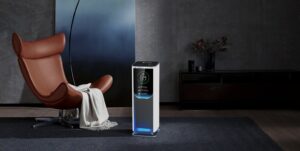



























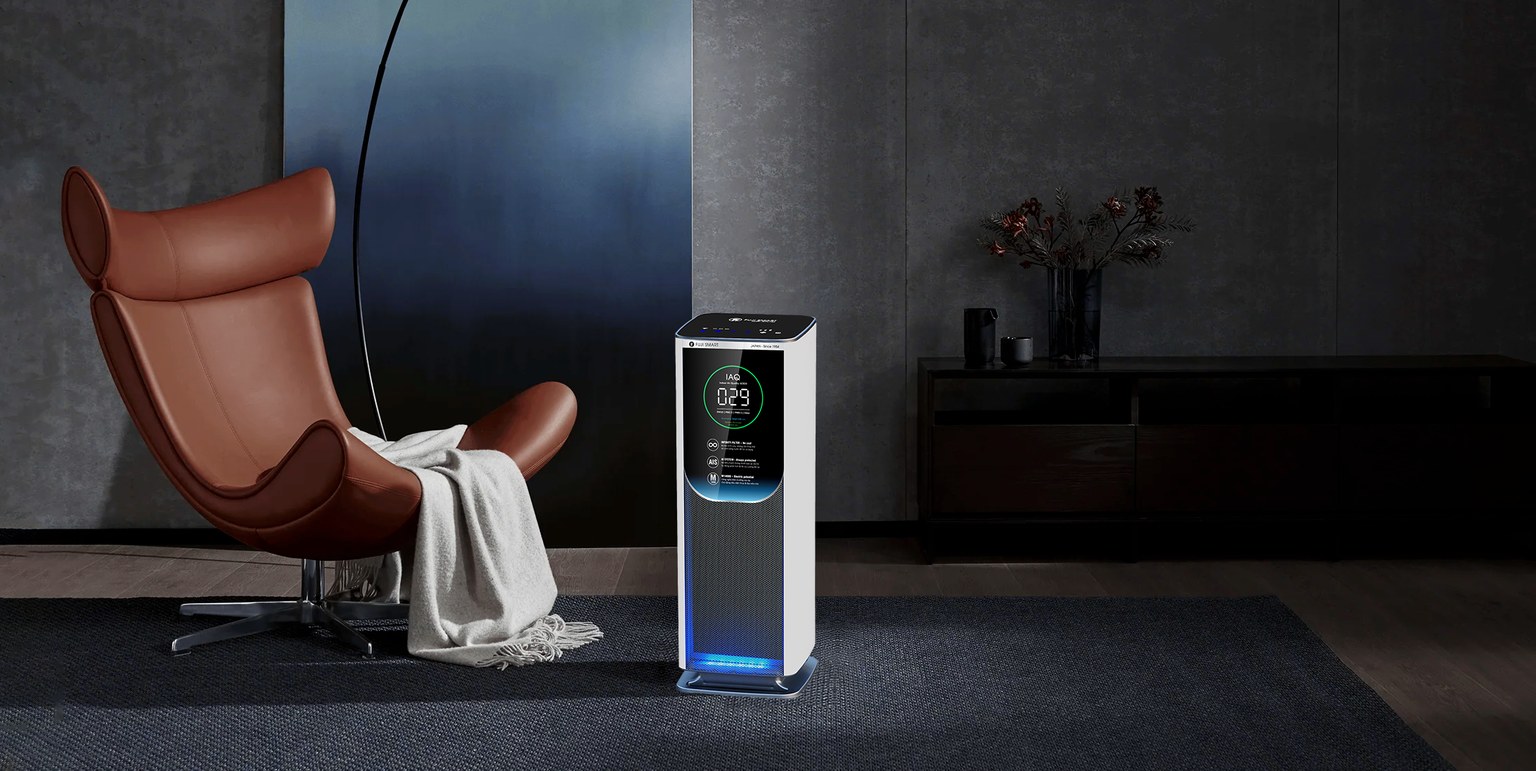
Almost every air purifier simply traps dust and microorganisms on the surface of its filter — they’re held there but remain fully intact, waiting for you on the day you pull out the old filter to replace it. The FUJI SMART AX-M14000 uses an M-14000 high-voltage electrostatic field to destroy bacteria and viruses the moment they pass through. With no barrier filter to clog, the entire filter system is washable with water and reusable for good.
01. The Fuji Smart M-14000 destroys viruses and bacteria, not just traps them like conventional filters
Conventional filters become a breeding ground for bacteria & viruses
Organic dust builds up on the filter, and in humid conditions it becomes the perfect environment for bacteria and mold to grow right on the filter itself, then blow a musty smell back into your room.
The risk of re-contamination when you change the filter
Every 6–12 months, you have to pull out a filter loaded with months of dust and microorganisms, right in the room the purifier just spent half a year cleaning. One shaky hand and it all goes back into the air.
With the AX-M14000, that never happens: you never have to replace a filter, and whatever collects on the collector plates has already been treated by the electrostatic field. You’re rinsing away residue, not handling a live colony of microbes.
How does a high-voltage electrostatic field kill bacteria and viruses?
The electric field “punctures” cell membranes
In a strong enough electric field, tiny pores open up in bacterial cell membranes (electroporation), the cell contents leak out, and the cell dies. The same principle is used to pasteurize juice without heat (see the scientific report published on the U.S. FDA website). View the research
Discharge creates ions and oxidizing radicals
High voltage ionizes the air (corona discharge), producing ions and reactive oxygen species such as OH·, O· and HO₂·. These attack the lipid layer of cell membranes and damage the proteins and outer envelope of viruses. View the research
Note: these results were measured under laboratory conditions, using each study’s own equipment and parameters. Real-world performance of any air purifier depends on voltage, how long air stays in the electrostatic field, humidity, and the specific design. These studies explain the science behind the technology; they are not test results for any specific product.
02. All four layers are washable — $0 in filter costs
Many other purifiers still require you to replace the activated-carbon filter on a regular schedule.
The AX-M14000 is different: all four layers, including the two catalytic activated-carbon filters, are built with new technology that lets you rinse them under clean running water and reuse them. That means odor and VOC removal stays effective for the long haul, with no replacement costs, ever.
Automatic filter-cleaning reminder
The hassle isn’t just the cost of filters, it’s keeping track: remembering which month the filter expires, ordering the right part, waiting for it to arrive, all while the purifier keeps running on an expired filter.
With the AX-M14000, that routine is gone. When the FILTER RESET light comes on (usually every 1–2 months, depending on pollution levels), just slide the filters out, rinse them with clean water, let them dry, and pop them back in. No expiration dates, no orders to place, no recurring costs.
FUJI SMART AX-M14000
- Maintenance: Rinse filters with water and reuse
- Activated-carbon layer: Washable
- Filter cost per year: $0
- After 3 years: $0
- After 5 years: $0
- Waste after 5 years: None
Conventional air purifier*
- Maintenance: Buy and install new filters
- Activated-carbon layer: Must be replaced
- Filter cost per year: approx. $50 – $80
- After 3 years: approx. $150 – $240
- After 5 years: approx. $250 – $400
- Waste after 5 years: 5 – 10 filter sets
* Replacement filter prices are approximate estimates for reference only and vary by brand, model and market.
03. Performance: CADR 300 m³/h (measured 362.3 m³/h) — cleans spaces up to 160 m² in 1.5 hours
CADR (Clean Air Delivery Rate) is the single most important metric for judging an air purifier: it tells you how many cubic meters of cleaned air the unit delivers every hour. The AX-M14000 is rated at 300 m³/h, and lab testing measured an actual 362.3 m³/h (report N260565-01C, GB/T 18801-2022).
The secret is its three fan motors spread across the entire front of the unit, pulling in and pushing out air along the full height of the purifier instead of through a small vent at the bottom like many other models.
(in a ~30 m² room)
What does that mean in real life? With a CADR of 300 m³/h (measured 362.3 m³/h), the purifier can clean all the air in a space of up to 160 m² in just 1.5 hours. In a 30 m² bedroom with a 2.7 m ceiling (about 81 m³ of air), the entire volume of air is refreshed about 3.7 times per hour — a completely fresh round of clean air roughly every 16 minutes.
That’s the level indoor air quality guidelines consider sufficient for bedrooms and home offices, all the way up to large spaces of 160 m² — the places where you spend the most time and need the cleanest air.
04. 70 m² or more? Use two purifiers instead of relying on one
CADR 300 m³/h (measured 362.3 m³/h) is measured under ideal conditions — no walls, no furniture in the way. Real homes always have partitions, cabinets and separate rooms, so in homes of around 70 m² or more, a single sterilizing air purifier, no matter how powerful, will struggle to cover the whole space evenly.
Walls and furniture create “dead air” zones
Place the purifier in the living room, and the airflow has to squeeze through doorways and around cabinets before it reaches the bedroom behind the wall. The farther it travels, the faster its intake and output weaken. The result: the room next to the purifier gets constant filtration, while rooms farther away are practically left out.
Dust and odors don’t come from just one place
Cooking fumes drifting from the kitchen, dust sneaking in through window gaps, dampness in the bathroom — each source pops up in a different corner of the home and won’t wait for the purifier to “get around to it.” A single unit in a fixed spot can’t keep up with these sources the moment they appear.
Relying on one purifier
It has to run nonstop on its highest fan speed just to pull air from distant rooms — noisier, and hard-to-reach corners still get missed.
Splitting between two purifiers
Each unit covers a closer area and circulates air faster, running at a quiet fan speed while still covering both sides of your home.
Because the AX-M14000’s filters are washable and reusable for years with no filter replacements, adding a second mid-size purifier for a larger space doesn’t mean doubling your long-term running costs. In return, clean air reaches every room, and each unit runs far more quietly than a single purifier struggling to do it all alone.
Harvard University CFD simulation study: multiple air purifiers vs. a single unit
- Researchers used Computational Fluid Dynamics (CFD) simulation to evaluate air-cleaning performance in an 8 × 8 × 3.5 m classroom, with occupants and a source emitting small airborne particles.
- The study compared one higher-capacity air cleaner (575 m³/h) with three lower-capacity air cleaners (190 m³/h each) — the two approaches provided approximately the same total clean air delivery rate.
- Instead of concentrating the total filtration capacity at a single point, the three smaller air cleaners were distributed across three different locations within the same room.
- Results: under the tested conditions with appropriate placement, the three distributed air cleaners resulted in a 27% lower average intake of airborne particles by occupants compared with one higher-capacity air cleaner positioned at a single location.
“The use of multiple PACs has the potential to outperform a single PAC.”
Air purification performance doesn’t depend only on the power of a single unit, but also on how clean airflow is distributed throughout the space.
In large areas, open-plan spaces or homes with multiple living zones, placing several purifiers in the right spots adds more air-treatment points, reduces poorly circulated zones, and keeps air quality more consistent.
So instead of relying on one high-capacity unit, a multi-purifier setup helps optimize cleaning performance in every area you use.
05. Compact at 21 × 21 × 55 cm — a footprint smaller than a sheet of A4 paper
Conventional air purifiers have to house thick, pleated filters with high airflow resistance — so they need a bulky body and a powerful fan to push enough air through. A high-voltage electrostatic field doesn’t need a bulky barrier: the open filter channels let air flow through easily, so the same airflow comes from a far smaller machine.
Think of the old CRT TVs — they were thick and heavy because the picture-tube technology demanded it. Today’s TVs are just a few centimeters thin, yet the picture is far better. The AX-M14000 is compact for exactly the same reason: modern technology makes the sleekest possible design possible.
Why is the AX-M14000 so compact?
The small size doesn’t come from cutting performance — it’s a direct result of the filtration technology inside:
No thick HEPA filter compartment
A HEPA filter has to be pleated into a block several centimeters thick for air to pass through, and the body must be large enough to hold it. The M-14000 electrostatic filter captures particles with electrostatic force across open electrode channels, so all four filter layers are thin panels stacked closely together.
Low airflow resistance, no oversized fan
Air passes through easily, so there’s no need for a big fan running hard to “force” air through a filter. Three small fan motors along the body still deliver a CADR of 300 m³/h (measured 362.3 m³/h) while drawing just 22W.
Vertical tower design
The unit makes full use of its 55 cm height, drawing in and blowing out air along the entire body. That keeps the base to just 21 × 21 cm (about 441 cm²) — roughly 30% smaller than a sheet of A4 paper (21 × 29.7 cm).
External power supply
The included 100–240V adapter sits outside the unit, so the body doesn’t need room for a large power module.
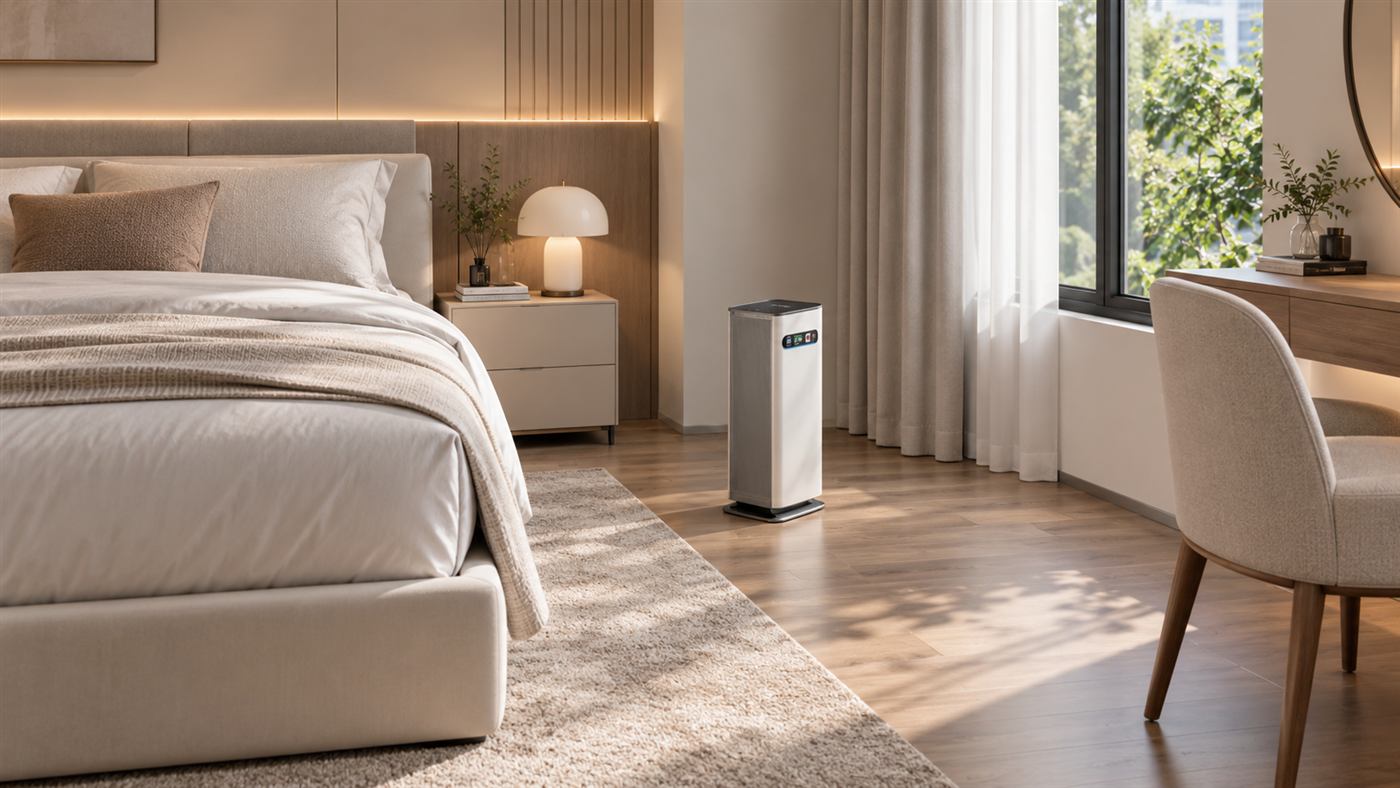
The result is a purifier that fits neatly beside your bed, under your desk or in a corner of the living room — spots where a HEPA-based purifier of the same capacity is often hard to place.
06. High-voltage electrostatic field vs. conventional filters
Both technologies clean the air, but how they do it — and what it costs you down the road — is fundamentally different.
M-14000 high-voltage electrostatic field
- How it works: Charges particles, then actively captures them with electrostatic force
- Bacteria and viruses: Disrupts their cell-membrane structure as they pass through
- Re-contamination risk: None — you never have to pull out and replace a dirty filter
- Airflow resistance: Low, with open channels — air flows through easily
- Performance over time: Restored to its original level after every wash
- Running cost: $0 in filter costs — rinse with water and reuse
- Unit size: Compact — no thick filter compartment needed
- Waste: No used filters to throw away
Conventional filter
- How it works: Mechanical blocking — particles are trapped when they hit the filter fibers
- Bacteria and viruses: Simply held intact on the fiber surface
- Re-contamination risk: Yes — every filter change can release trapped microbes back into the room
- Airflow resistance: High, and it increases over time as the filter clogs with dust
- Performance over time: Gradually declines until the filter is replaced
- Running cost: Regular filter replacements every 6–12 months
- Unit size: Bulkier to compensate for filter resistance
- Waste: 1–2 filter sets thrown away every year
07. Four filter layers and what each one does
Dirty air is drawn in at the back of the unit, passes through four filter layers in turn, and comes out clean at the front:
1
Primary Filter — Pre-filter
Traps hair, pet fur, lint and large dust — protecting the three layers behind it.
2
M-14000 Filter — High-voltage electrostatic field
The heart of the purifier: disrupts the structure of bacteria and viruses and captures ultrafine particles down to 0.0146 micron.
3+4
2 catalytic activated-carbon filters
Each filter combines activated carbon (which adsorbs odors and VOCs: cooking smells, cigarette smoke, pet odors, paint and chemicals) with an MnO₂ catalyst (which breaks down formaldehyde from engineered wood, adhesives and fresh paint into water vapor and CO₂ — rather than just holding it temporarily). The two layers sit back to back, so air is treated twice for greater effectiveness.
Dual catalytic activated-carbon filters: breaking down, not just trapping
Ordinary purifiers rely on activated carbon alone, which adsorbs formaldehyde and holds it inside — once the carbon is saturated, it stops working. The AX-M14000’s dual catalytic activated-carbon filters add an MnO₂ catalyst that breaks formaldehyde down into water (H₂O) and CO₂, so it doesn’t build up and effectiveness doesn’t fade over time.
08. 22W — about the power of a light bulb
An air purifier only does its job when it runs continuously. That makes power consumption just as important as filtration performance — and this is where the electrostatic design really shines: with low airflow resistance, the fan doesn’t have to work hard.
Running the unit around the clock uses about 0.53 kWh — roughly $0.06 of electricity a day (at a typical residential rate of about $0.12/kWh). In other words, you can leave it running nonstop for a whole month for about the price of a cup of coffee.
In operation, the unit produces only about 30 dB of noise — about as quiet as an air conditioner on its gentlest setting, blending almost seamlessly into the background. In Sleep mode, the fan drops to its lowest speed for even quieter operation, so it can run all night in your bedroom without disturbing you.
09. Air quality sensor and automatic mode
The AX-M14000 features an air quality sensor on the back of the unit. When switched on, it defaults to Automatic mode: the system reads sensor data in real time and adjusts filtration intensity on its own. When it detects more pollutants in the air, it automatically ramps up; once air quality has stabilized, it steps back down to an appropriate level to save energy. No manual adjustments needed.
Three-color LED indicator
The LED light strip on the body shows you the air quality at a glance from across the room — no need to check your phone:
- Blue — good air quality
- Yellow — moderate air quality
- Red — polluted air; the purifier is boosting filtration
When you first turn the unit on, the light blinks for about 5 seconds — that’s the sensor preheating — before it displays the color that reflects the actual air quality.
Lunar White night-light mode
If the three-color light bothers you while you sleep, press and hold the light button for 3 seconds to switch to Lunar White mode — a soft white glow like a night light. Hold it for another 3 seconds to turn the light off completely; only the light button stays dimly lit. A single light tap brings the light and all control-panel indicators back on.
10. Touch Control Panel and Function Keys
Every control sits on the touch panel on top of the unit: no mechanical buttons, intuitive to use, and easy to wipe clean.
11. Wi-Fi Connectivity and Remote Control
Beyond the touch panel, the AX-M14000 connects to a smartphone app, so you can monitor your air quality and control every function right from your phone. Switch it on before you get home, or change modes without getting off the couch.
12. Proper Cleaning and Maintenance
Because the filters are reusable, regular cleaning is the purifier’s entire “maintenance cost.” Do it right, and performance is restored almost completely.
The purifier also reminds you at the right time: when the FILTER RESET symbol lights up red along with the other symbols on the control panel, it is time to wash the filters, typically every 1–2 months depending on the pollution levels where you live.
Filter removal order
- Remove the control panel on top of the unit in the direction shown by the arrow.
- Lift out, one at a time: M-14000 electrostatic filter → pre-filter → 2 catalytic activated-carbon filters.
- Once everything is cleaned and completely dry, reinstall in the reverse order.
Cleaning the pre-filter and the 2 catalytic activated-carbon filters
Vacuum the dust off the surface, or rinse the filters directly under running water. The filters must be completely dry before you put them back in the unit.
Cleaning the M-14000 electrostatic filter
- Squeeze out some neutral detergent, apply it to the cleaning brush, and brush evenly back and forth across the filter surface.
- When the front is done, flip the filter over and brush the back until both sides are covered with the solution.
- Let it sit for about 15 minutes so the dirt dissolves into the solution.
- Rinse with clean water until all detergent and foam are gone. If any residue remains, dip the cleaning brush in water and brush it away.
- Let it dry completely before reinstalling.
Three things to avoid when cleaning the M-14000 electrostatic filter:
- Do not touch the high-voltage discharge needle plate inside the unit; it can cause injury.
- Do not clean with hot water or any high-temperature method.
- Wear gloves to protect your skin from the detergent.
Once everything is reassembled, don’t forget to reset the filter: press the Light and Automatic keys together for 3 seconds. If you skip this step, the purifier may not restart normally.
13. Full Technical Specifications
14. Fuji Japan — 72 Years in Healthcare Equipment
The AX-M14000 was developed by Fuji Japan, a Japanese healthcare equipment group with more than 72 years of experience.
That background explains a lot about this purifier. A company rooted in healthcare doesn’t stop at asking “how do we filter out the dust?” It goes on to ask “what happens to the bacteria once they’re captured?” That is exactly why the M-14000 was designed to sterilize, not just to filter. Fuji Japan’s research foundation is also what allowed it to fit high-voltage electrostatic field technology and a no-replacement filter system into a design compact enough for modern living spaces.
15. Who Is the AX-M14000 For?
Families with young children
Children breathe more air per pound of body weight than adults, and their respiratory systems are still developing. The child lock and gentle night light make it a great fit right in the nursery.
People with allergic rhinitis or asthma
Dust mites, pollen and pet dander are the most common irritants, and they’re exactly the kind of particles the high-voltage electrostatic field handles well.
Newly furnished homes
Engineered wood, adhesives and fresh paint release formaldehyde over a long period. The 2 catalytic activated-carbon filters break this gas down instead of just holding it temporarily.
Pet owners
Shed hair, dander and pet odors are handled by the pre-filter together with the 2 catalytic activated-carbon filters, and every one of them is washable.
Bedrooms and small home offices
At 21 × 21 × 55 cm, it fits easily beside the bed or under a desk. Sleep mode runs quietly and the display turns off automatically, so it won’t disturb your sleep.
Anyone tired of ongoing costs
If you’ve ever given up on an air purifier because replacing filters was a hassle, this is the model for you: buy it once, with no recurring expenses and no maintenance schedule to remember.
16. What’s Really in the Air Inside Your Home?
Group 1 — Particulate pollution
PM10 and PM2.5 fine dust drifting in from the street; pet hair and dander; dust mites in mattresses, pillows and carpets; pollen; lint from bedding and clothing. Along with them come bacteria, mold and viruses riding on those very particles, since dust is how they travel. This is the group behind sneezing, itchy noses and nighttime coughing, and it can make asthma and allergic rhinitis worse.
Group 2 — Gaseous pollution
Formaldehyde is released from engineered wood, adhesives, paint and new furniture, and this off-gassing can continue for years. Add to that volatile organic compounds (VOCs) from cleaning products, air fresheners, cooking fumes and cigarette smoke. This group can’t be removed by mechanical blocking; it has to be adsorbed or broken down catalytically.
The AX-M14000 is designed to tackle both groups at once with four filter layers: the pre-filter and high-voltage electrostatic field handle particulate pollution, while the 2 catalytic activated-carbon filters handle gaseous pollution.
17. How the M-14000 High-Voltage Electrostatic Field Works
M-14000 is an Electric Potential technology: it creates a high-voltage electrostatic field inside the filter chamber that actively charges dust particles and then pulls them in, rather than waiting for them to bump into a mesh on their own. It works in three stages:
1
Ionization — charging the particles
As air passes through the high-voltage discharge zone, airborne dust, pollen, droplets and microorganisms pick up an electrical charge, turning from neutral into charged particles.
2
Sterilization — breaking down structures
The high voltage ruptures bacterial cell membranes and disrupts the structure of viruses carried on dust particles, right inside the electrostatic field. According to the manufacturer, no harmful by-products are produced.
3
Collection — gathered in one place
Charged particles are attracted and firmly held by an oppositely charged collector, concentrating pollutants in one dedicated spot inside the unit instead of letting them drift back into the room.
Something you see every day
The principle behind stage 3 is simple: opposite charges attract. It’s the same reason dust always builds up so thickly on the components inside a desktop computer, thanks to the static electricity generated while it runs.
The AX-M14000 harnesses that same phenomenon, but in an active, controlled way: it charges dust particles and then draws them onto an oppositely charged collector. Pollutants are gathered in a single spot where they can no longer survive, multiply or spread back into the room.
This lets the purifier handle ultra-fine particles that mechanical meshes struggle to trap. The manufacturer states it can capture particles as small as 0.0146 micron, about 170 times smaller than the PM2.5 fine-dust threshold.
18. Frequently Asked Questions
Can a regular air purifier kill bacteria?
No. A conventional filter is a mechanical mesh of fibers — its job is to trap particles on its surface. Bacteria and viruses caught there stay fully intact on the filter fibers. That’s why the AX-M14000 uses a high-voltage electrostatic field: it breaks down their structure the moment they pass through, instead of storing them inside the machine.
Do the filters really never need replacing?
All four filter layers — including the two catalytic activated-carbon filters — are designed to be washed with water and reused, so under normal use you never have to buy replacement filters. What you do need to do is clean them regularly and let them dry completely before reinstalling.
Is it noisy? Can I use it in the bedroom?
It’s very quiet — operating noise is only about 30 dB, similar to an air conditioner running on low, and you’ll barely notice it during everyday life. At night, just switch to Sleep Mode: the fan drops to its lowest speed for even quieter operation, and you can turn off the indicator lights for a completely dark room.
Is such a compact unit really powerful enough for spaces up to 160 m²?
Yes. The compact size comes from eliminating the thick, bulky filter — not from cutting performance. CADR is still 300 m³/h (measured 362.3 m³/h), cleaning spaces up to 160 m² in 1.5 hours. It’s a lot like how today’s TVs are far thinner than old CRT sets, yet deliver a much better picture.
Where is the best place to put it?
Place it on a flat floor surface, leave clearance behind it so the air intake isn’t blocked, and avoid pushing it against a wall or behind curtains. Do not use it in bathrooms (high humidity), greasy kitchens, or anywhere with flammable gases.
Does it work without Wi-Fi?
Yes. Wi-Fi is only for remote control from your phone. All purification functions, Auto mode, the timer and the child lock work independently from the touch panel.
Why does the Wi-Fi connection fail?
The most common cause is that your phone is connected to a 5GHz band. The unit supports 2.4GHz Wi-Fi only — separate the two bands on your router, then try pairing again. Note that the unit automatically exits pairing mode after 3 minutes.
Safety precautions: Use only a 100–240V~ 50/60Hz power supply. Never touch the plug with wet hands, and always unplug by holding the plug body. Disconnect power before cleaning or maintenance. If the power cord is damaged, it must be replaced by a qualified technician. Keep out of reach of children and supervise children when they are near the unit. Do not insert fingers or metal objects into the air vents. Keep away from volatile substances, burning incense and lit cigarettes. Do not use in bathrooms, greasy kitchens or places with flammable gases.
Technical specifications in this article are taken from the official FUJI SMART AX-M14000 user manual. The manufacturer reserves the right to change specifications without prior notice. Estimates of electricity use and replacement-filter costs are for reference only and may vary by region.
- CADR 362.3 m³/h: Clean air delivery rate for particulate matter, determined by a test method using cigarette smoke. Report No. N260565-01C, dated November 16, 2026, in accordance with GB/T 18801-2022.
- Power 21.8W: Electrical power recorded during the CADR test with the unit running at its highest fan speed on a 220V/50Hz power supply. Report No. N260565-01C.
- Cleaning efficiency 16.6 m³/(h·W): A measure of clean air delivered per watt of electrical power consumed. Calculated from the CADR result of 362.3 m³/h and the measured power of 21.8W: 362.3 ÷ 21.8 ≈ 16.6 m³/(h·W). Report No. N260565-01C.
- Particle concentration reduced by approximately 98.1% after 20 minutes: In the cigarette-smoke test, with the unit running, particle concentration fell from 8,343,074 particles/L at the start to 154,770 particles/L after 20 minutes. The reduction rate is calculated from the measured data: (8,343,074 − 154,770) / 8,343,074 × 100 ≈ 98.1%. Result calculated from the measurement data in report N260565-01C. This is the reduction in particle concentration under test conditions, not a guaranteed removal rate in every space.
- Particle concentration decay constant 0.2015 min⁻¹: Value recorded with the Fuji Smart AX-M14000 running at its highest fan speed. The natural decay constant with the unit switched off is 0.0002 min⁻¹. These parameters were determined by measuring particle concentration every 2 minutes, continuously for 20 minutes. Data from report N260565-01C.
- CADR test conditions: Test using cigarette smoke, Suxin SX-L301N particle counter, ambient temperature 24.7°C, relative humidity 48.3% RH. The unit was operated at its highest fan speed on a 220V/50Hz power supply. Test method referenced to GB/T 18801-2022.
- Scope of results: The CADR, power and cleaning efficiency figures were recorded on a Fuji Smart AX-M14000 sample unit under the test conditions stated above. Actual cleaning performance may vary depending on floor area, room volume, pollution level, unit placement, operating mode and filter condition.
Reviews
There are no reviews yet.